


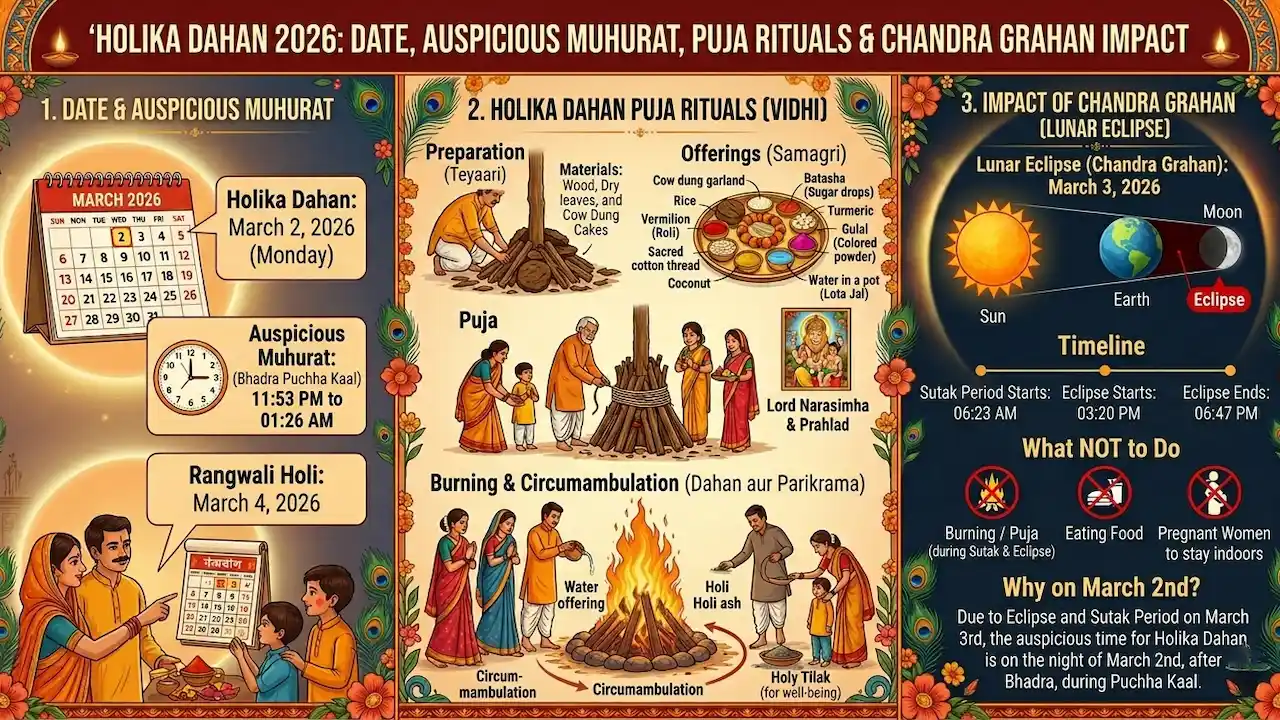
Holika Dahan 2026: As the harsh winds of winter recede and the vibrant warmth of spring begins to bloom, India prepares for its most colorful festival. But before the skies are painted with Gulal on Rangwali Holi, the country unites to witness the sacred fires of Holika Dahan. Also known as Chhoti Holi or Jalanewali Holi, this ancient ritual is a powerful symbol of the victory of good over evil, devotion over arrogance, and light over darkness. In 2026, Holika Dahan holds a special astrological significance due to the rare occurrence of a Lunar Eclipse (Chandra Grahan) on the same day. Whether you are in a bustling city or a quiet village, gathering around the roaring bonfire on the night of Phalguna Purnima is an experience that cleanses both the environment and the soul.
Holika Dahan 2026 Date and the Chandra Grahan Impact:
Determining the exact date and timing for Holika Dahan requires precise astrological calculations based on the Hindu Panchang. The ritual must be performed during the Pradosh Kaal (post-sunset) on the Purnima (full moon) night, ensuring that the inauspicious Bhadra Kaal has passed.
In 2026, there is significant confusion because Purnima spans across March 2 and March 3, and a Lunar Eclipse coincides with the festival.


- Holika Dahan 2026 Date: March 3, 2026 (Tuesday)
- Rangwali Holi (Dhulandi): March 4, 2026 (Wednesday)
The Lunar Eclipse (Chandra Grahan) and Sutak Kaal:
On March 3, 2026, a Lunar Eclipse will be visible in India in the late afternoon and evening. According to Hindu traditions, a Sutak Kaal (a period of abstention from religious activities) is observed during an eclipse.
- The eclipse and Sutak Kaal will officially end around 06:47 PM IST.
- Therefore, the Shubh Muhurat (Auspicious Timing) for lighting the Holika pyre in 2026 is strictly after the eclipse concludes.
- Exact Muhurat: 06:47 PM to 08:50 PM on March 3, 2026.
The Legendary Tale of Prahlad, Hiranyakashipu, and Holika
To understand the profound emotion behind Holika Dahan, one must delve into the Puranic legend of Lord Vishnu’s greatest devotee, Prahlad.
The Arrogance of the Demon King:
Hiranyakashipu, a powerful demon king, had obtained a boon from Lord Brahma that made him virtually indestructible. Intoxicated by this power, he demanded that everyone in his kingdom worship only him. However, his own son, Prahlad, was an ardent devotee of Lord Vishnu (Lord Narayana). Despite severe punishments, Prahlad refused to stop chanting Vishnu’s name.
The Sinister Plan:
Furious, Hiranyakashipu sought the help of his sister, Holika. She possessed a magical cloak (or a divine boon) that made her immune to fire. The king ordered Holika to sit on a burning pyre with young Prahlad in her lap, intending to burn the child alive while Holika remained unharmed.
The Divine Intervention:
As the fire roared, Prahlad calmly chanted “Om Namo Narayanaya.” A miraculous gust of wind blew the magical cloak off Holika and wrapped it around Prahlad. The demoness Holika, representing evil and malicious intent, was reduced to ashes, while Prahlad emerged completely unscathed. This majestic triumph of true devotion over tyrannical evil is exactly what we celebrate every year by burning the effigy of Holika.
Holika Dahan 2026: Quick Reference Table
| Crucial Aspect | Details for 2026 |
|---|---|
| Holika Dahan Date | March 3, 2026 (Tuesday) |
| Shubh Muhurat (Puja Time) | 06:47 PM to 08:50 PM |
| Eclipse Impact | Pyre must be lit only after the Chandra Grahan ends |
| Significance | Triumph of Good over Evil |
| Key Offerings | Cow dung toys (Badkula), raw yarn, barley, coconut |
| Next Day Festival | Rangwali Holi (March 4, 2026) |
The Scientific and Ayurvedic Significance of the Bonfire
Hindu festivals are deeply intertwined with the cycles of nature. Holika Dahan occurs during the transition between the cold winter and the warm spring, a period known in Ayurveda as Ritu Sandhi.
- Eradicating Winter Bacteria: During this seasonal shift, the sudden change in temperature promotes the growth of bacteria in the atmosphere and causes lethargy (Tamas) in the human body. The intense heat generated by the massive Holika bonfire—which traditionally includes camphor, mustard seeds, neem leaves, and cow dung—acts as a natural fumigant.
- The Parikrama (Circumambulation): When people walk around the fire (Parikrama), the heat helps cleanse the body of accumulated winter bacteria and invigorates the mind, preparing it for the active spring season.
- Celebrating the Harvest: Holika Dahan is also an agricultural celebration. The new harvest, especially stalks of wheat and barley, is offered into the holy fire. The roasted grains, known as Holka, are then distributed as Prasad.
Holika Dahan Puja Vidhi: How to Perform the Rituals
The preparation for the bonfire begins days in advance. A log of wood is placed in a prominent public square, and people contribute twigs, dried leaves, and cow dung cakes to build the pyre. An effigy of Holika (made of combustible materials) and Prahlad (made of non-combustible materials) is placed at the top.
Step-by-Step Puja Process:
- Purification: Take a bath and wear clean, traditional clothes before attending the puja.
- The Thali Preparation: A Puja Thali should contain a Kalash of water, Roli (vermilion), Akshat (uncooked rice), fragrant flowers, raw cotton thread, turmeric, whole moong daal, Batasha (sugar candies), and freshly harvested crops (like wheat or barley).
- Offering and Tying the Thread: Devotees tie the raw cotton thread around the pyre three to seven times in a clockwise direction.
- Lighting the Fire: Once the Shubh Muhurat begins (after 06:47 PM in 2026), the pyre is lit by a community elder or priest.
- The Holy Ash (Bhasma): The next morning, before playing with colors, it is a tradition to bring the cold ashes of the Holika fire back home. Applying this ash on the forehead is believed to ward off diseases and negative energies.
Regional Variations: How India Lights Up
While the core emotion remains the same, different regions of India observe this night with unique mythological contexts:
- Kama Dahanam (South India): In states like Tamil Nadu and Karnataka, this day is associated with the legend of Lord Shiva and Kamadeva (the God of Love). It is believed that Lord Shiva, enraged by Kamadeva for breaking his deep meditation, opened his third eye and burned Kamadeva to ashes. Hence, the bonfire is called Kama Dahanam.
- Dol Purnima (West Bengal): In Bengal, Holika Dahan is generally not celebrated with a massive bonfire. Instead, the day is marked as Dol Jatra or Basanta Utsav. It focuses on the divine romance of Radha and Krishna, where their idols are placed on a decorated palanquin and swung (Dol) while devotees sing Rabindra Sangeet.
- Lathmar Holi Preparations (Uttar Pradesh): In the Braj region (Mathura, Vrindavan, Barsana), the Holika pyre marks the culmination of weeks of festivities and sets the stage for the grand, chaotic, and deeply spiritual color play of the following morning.
5 Tips to Celebrate Holika Dahan 2026
- Wait for the Eclipse to End: Since 2026 features a Lunar Eclipse, strictly follow the astrological advice to light the fire and perform the Puja only after 06:47 PM to ensure positive energy.
- Eco-Friendly Bonfires: Avoid burning plastic, rubber, or toxic waste. Use only dry wood, agricultural waste, and cow dung cakes to ensure the smoke purifies rather than pollutes the air.
- Donate to the Needy: The conclusion of a lunar eclipse is an excellent time for charity. Donate clothes, food, or grains to the less fortunate before you head out for the Holika Dahan puja.
- Protect Your Eyes and Skin: Stand at a safe distance from the massive flames, as the heat can be overwhelming. Keep children securely by your side during the Parikrama.
- Burn Your Inner Negativity: As you watch the effigy burn, make a conscious mental resolution to throw your ego, jealousy, and bad habits into the fire. Start the next morning with a clean slate.
Frequently Asked Questions (FAQ)
- Why is Holika Dahan 2026 delayed until the late evening? Due to the occurrence of a Chandra Grahan (Lunar Eclipse) on March 3, 2026, the Sutak Kaal prohibits auspicious rituals. The puja must be done only after the eclipse ends at 06:47 PM.
- What do we do with the leftover ash of Holika Dahan? The leftover ash, called Vibhuti or Bhasma, is considered highly sacred. It is applied to the forehead to protect against evil eyes and is sometimes sprinkled in the corners of the house to bring prosperity.
- Is Holika Dahan a public holiday? While the next day (Rangwali Holi) is a major national holiday, Holika Dahan is a restricted holiday. However, many schools and offices close early so families can prepare for the evening rituals.
Conclusion:
Holika Dahan 2026 is a profound reminder that no matter how powerful arrogance or evil may seem, it is ultimately consumed by the fire of truth and devotion. As the flames touch the night sky on March 3, 2026, let them consume our anxieties and past grievances. The warmth of the fire is a promise of the vibrant, colorful spring that awaits us the very next morning. Gather your family, seek the blessings of the fire, and get ready for a joyous Dhulandi!
Technical SEO Details:
- Permalink: holika-dahan-2026-date-muhurat-chandra-grahan-impact
- Tags: Holika Dahan 2026, Chhoti Holi Date 2026, Holi Lunar Eclipse 2026, Holika Dahan Shubh Muhurat, Prahlad Holika Story, Kama Dahanam, Holika Puja Vidhi.
- Excerpt: Find out the exact date and Shubh Muhurat for Holika Dahan 2026. Learn how the Lunar Eclipse (Chandra Grahan) on March 3 impacts the Puja timings, and discover the scientific and mythological significance of Chhoti Holi.